Orbán says only Fidesz can guarantee peace at “anti-war” rally in Szeged
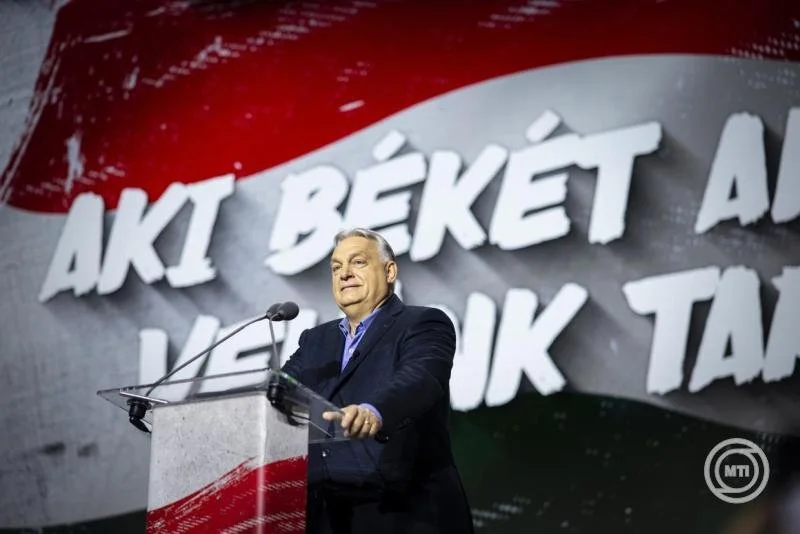
Handout image released by the Prime Minister’s Communications Department. Prime Minister Viktor Orbán delivers a speech at an anti-war rally organized by the Digital Civic Circles in Szeged on Dec. 20, 2025. MTI / Prime Minister’s Communications Department / Zoltán Fischer
Hungarian Prime Minister Viktor Orbán used a government-backed “anti-war” rally in Szeged on Saturday to argue that only his Fidesz party can protect Hungary from war, migration and economic decline, as critics and independent media pointed to signs of tightly managed political mobilization behind the event.
Speaking before a packed crowd at the Pick Arena, Orbán said that without Fidesz, Hungary would face war, mass migration and declining birth rates, repeating a core message of his party’s campaign ahead of the 2026 parliamentary election. “If there is no Fidesz, there is no party,” Orbán said, using a slogan that framed his party as synonymous with stability and prosperity.
The event was organized by the Digital Civic Circles (DPK), a network launched by Fidesz-aligned figures, and marked the fifth and final stop this year of Orbán’s anti-war tour, which began in the fall. Several senior government officials attended, including Cabinet Office head Antal Rogán, Prime Minister’s Office Minister Gergely Gulyás, Construction and Transport Minister János Lázár, Culture and Innovation Minister Balázs Hankó, and Justice Minister Bence Tuzson.
Orbán appeared on stage alongside Lázár for a live question-and-answer session known as “Lázárinfo.” He said voters were not choosing him personally but a “community” capable of supplying different leaders depending on the country’s needs, naming former President János Áder, Lázár and former finance minister Mihály Varga as examples.
Former President Áder delivered a lengthy presentation praising infrastructure, cultural and social investments made over the past 15 years, arguing that Hungary has “something to lose” and warning against what he described as dangerous “fantasizing about war.” He cited highways, hospitals, cultural renovations and environmental projects as evidence of national progress.
The rally also featured sharp exchanges. According to independent outlet Telex, one audience member asked Orbán why the government was “lying” about a child-protection report and whom it was allegedly shielding in abuse cases. The crowd booed the questioner before Lázár intervened, asking that he be allowed to speak. Orbán responded by saying more child abusers are imprisoned now than before 2010 and later argued that juvenile reform institutions should be placed under the prison system.
On foreign policy, Orbán said Hungary had helped avert a “direct war risk” in the European Union by opposing the seizure of frozen Russian assets for Ukraine. He warned that the 2026 election could be “the last” before Europe is drawn deeper into the conflict and claimed Hungary could be pulled into war by the end of the decade if Fidesz loses power.
While state-run Hungarian News Agency coverage focused on speeches and policy claims, independent media reported details suggesting broader political orchestration. Multiple outlets, including Telex and regional news sites, reported that attendees were transported to Szeged by bus from several parts of Hungary, as well as from neighboring Serbia’s Vojvodina region, where a Hungarian minority lives. Photos and eyewitness accounts showed buses parked near the arena.
Media outlets also reported that paid social media advertisements were used to recruit participants for the event. According to those reports, the advertisements were taken down after journalists began reporting on them.
The rally drew controversy over the distribution of a tabloid-style leaflet published by Bors, which accused the opposition Tisza Party of planning tax hikes. A court ruling had ordered the publication’s distribution halted, but journalists observed copies being handed out inside the arena. Event hosts referred to the ban as “alleged,” and the publisher later said distributors had not been formally notified.
Orbán later posted photos of the rally on Facebook under the title “The Biggest of This Year,” underscoring the political significance of the event in a city where opposition parties have recently shown electoral strength. In the 2024 European Parliament election, the opposition Tisza Party won more votes in Szeged than Fidesz, highlighting the city’s importance ahead of the next national vote.
The Szeged rally illustrated both Orbán’s continued focus on framing the war in Ukraine as an existential threat to Hungary and the sharp divide between state-aligned messaging and independent media reporting in the country’s political landscape.
In the afternoon, opposition leader Péter Magyar held a rally at Széchenyi Square.
