Developing: What Szeged residents need to know about Hungary's electricity and water emergency
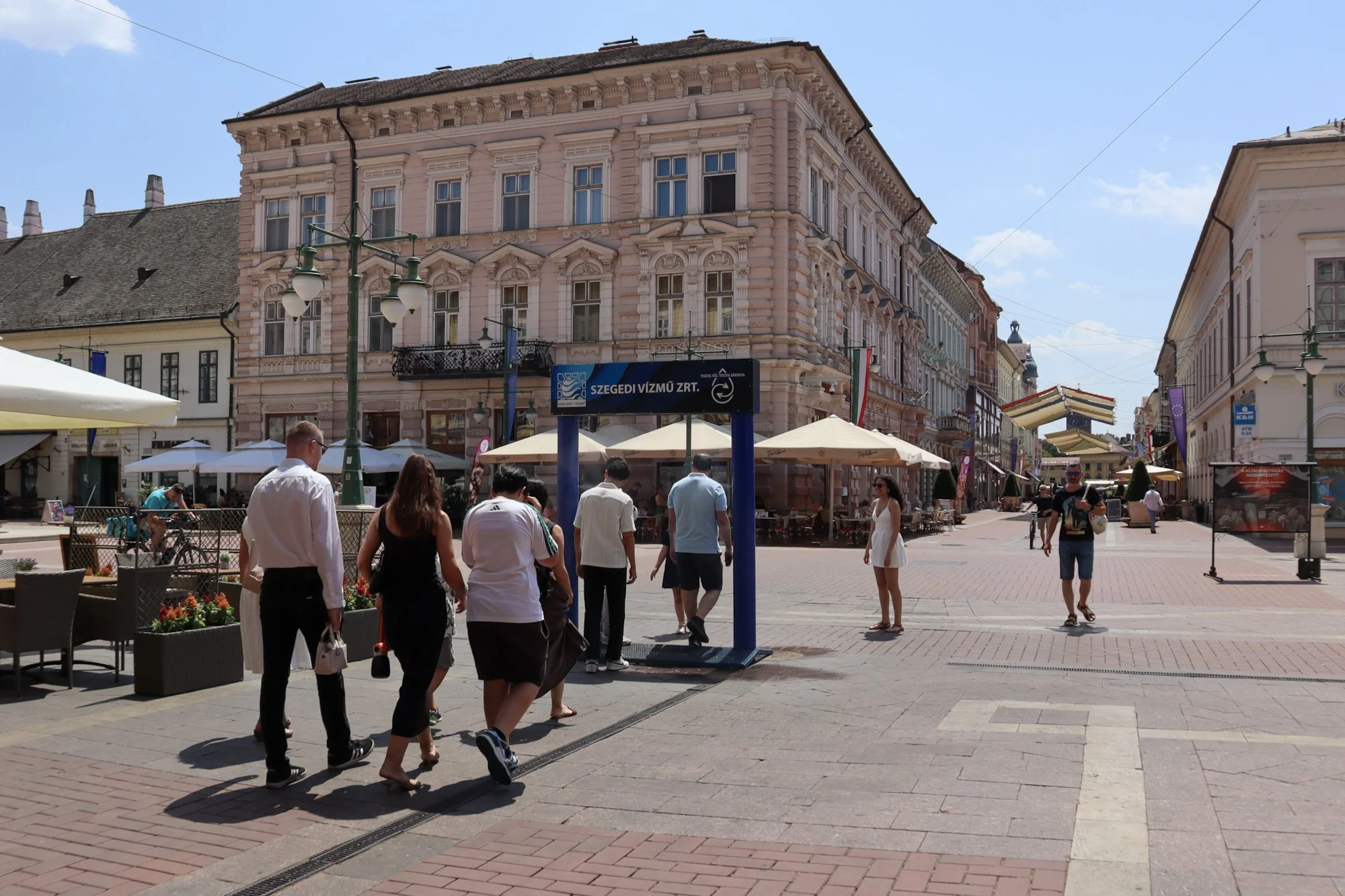
People walking towards a misting arch in the center of Szeged during a previous heatwave. File photo. Szilvia Molnar / Szegedify
Updated Aug. 10, 2026
SZEGED, Hungary — Residents of Szeged remain subject to nationwide water-use restrictions and a fire ban as Hungary continues to respond to an electricity and water emergency caused by prolonged drought, extreme heat, and historically low water levels on the Danube.
The government's emergency response remains in effect after low Danube water levels forced the Paks Nuclear Power Plant to progressively reduce its output. On Monday, Prime Minister Péter Magyar said engineers had found a way to keep the plant's last operating 240-megawatt turbine running through Monday and possibly Tuesday by reducing the amount of cooling water required at the facility. He said the measure temporarily postpones what would have been the plant's first complete shutdown in its 44-year history, but cautioned that a full shutdown remains possible if river levels continue to fall. He emphasized that nuclear safety remains the government's top priority.
According to the government, households, businesses, municipalities, and public institutions reduced electricity consumption by about 700 megawatts on Sunday, helping maintain the stability of Hungary's electricity system during one of the summer's highest-demand periods.
Although the situation remains fluid, no mandatory electricity restrictions have been announced for residential consumers, and the immediate impact for residents is limited to existing water-use restrictions, the nationwide fire ban, and voluntary efforts to reduce electricity consumption.
What you need to know
Level I water-use restrictions are in effect nationwide, including in Szeged.
A nationwide fire ban remains in force.
No residential power cuts have been announced.
Households would be the last group affected if electricity restrictions become necessary.
Authorities are urging people to conserve both water and electricity.
Level I water-use restrictions already apply in Szeged
Update, Aug. 10, 2026: The government subsequently clarified that its announcement of a nationwide Level I water restriction was incorrect. Water restrictions are imposed by individual municipalities, and Szeged has not introduced a water-use restriction. The city's water supply remains secure.
A nationwide Level I water-use restriction entered into force on July 31 and applies in every municipality in Hungary, including Szeged.
The measures are intended to reduce the use of treated drinking water for non-essential purposes as prolonged drought continues to put pressure on the country's water resources.
Under the restrictions, residents are prohibited from:
watering gardens, lawns, or parks with drinking water using a hose;
filling private swimming pools with mains water;
washing vehicles with a hose;
washing roads, pavements, or courtyards with tap water; and
operating automatic irrigation systems.
The government has also instructed water authorities to introduce Level III water restrictions wherever necessary to safeguard drinking water supplies. Those stricter restrictions have not been introduced nationwide and would only apply in areas where local conditions make them necessary.
Nationwide fire ban remains in effect
A nationwide fire ban also remains in force because of the prolonged heatwave and exceptionally dry conditions.
Open fires are prohibited in forests, wooded areas, and within 200 meters (656 feet) of them, including designated forest fire pits. Burning stubble, grass, and other vegetation is also prohibited.
Authorities note that enclosed gas-powered cooking equipment is generally not considered an open fire under the regulation. Even so, residents are urged to exercise extreme caution outdoors because vegetation is unusually dry and fires can spread rapidly.
No residential power restrictions announced
Despite the deteriorating energy situation, no electricity restrictions have been announced for households.
According to the government, any mandatory electricity restrictions would first target major industrial consumers before affecting residential users. Hundreds of companies have already reorganized production and voluntarily reduced electricity consumption. If the security of Hungary's electricity supply requires it, the government says mandatory consumption reductions could be introduced and large consumers could be temporarily disconnected from the grid.
To reduce pressure on the electricity grid during the peak demand period, the government has suspended rail freight operations between 5 p.m. and 10 p.m., required remote work for eligible public-sector employees, and switched off decorative lighting at state institutions. Private employers have also been urged to allow employees to work from home where possible, and reduce energy use in office buildings.
Authorities are asking residents to postpone non-essential electricity use between 5 p.m. and 10 p.m., when demand on the national grid is highest. The request includes delaying activities such as electric vehicle charging, running washing machines or dishwashers, and other energy-intensive household tasks where possible.
Officials say Monday, Aug. 3, marks the beginning of what they expect to be the five most challenging days of the current heatwave, with record temperatures forecast and no significant rainfall expected to improve drought conditions or raise Danube water levels.
Public fountains now operate on a reduced schedule
Szeged has also introduced local energy-saving measures affecting several of the city’s public fountains.
Since Aug. 4, fountains have been operating daily from 7 p.m. to 11 p.m. as part of efforts to reduce electricity consumption during the ongoing energy emergency.
According to the Szegedi Környezetgazdálkodási Nonprofit Kft., smaller fountains that cannot maintain adequate water circulation outside operating hours have been temporarily drained to prevent water quality from deteriorating in the summer heat.
Decorative lighting has also been switched off at older fountains as an energy-saving measure. The fountain in Móra Park remains illuminated in the evenings thanks to its energy-efficient LED lighting.
Featured image only for illustration. Szegedify file / Szilvia Molnar
Update, Aug. 10, 2026: Hungary has since lifted several emergency electricity-saving measures as energy supplies stabilized and conditions at the Paks Nuclear Power Plant began to improve. Read our latest update here.